Natuur en GezondheidsCentrum (NGC) | Tuinbouwweg 19c in Maarssen
8.30 am until about 6.30 pm
The history of NRT and the benefits of this new special therapy
Explanation of Reciprocal Inhibition and the Law of Symmetry
Explanation of mechanoreceptors
Contraindications
Palpation skills
How and when to apply NRT
Explanation of zones in the body according to the NRT principle
Muscles explained from the middle back (last rib) to the jaw plus their corresponding MUSCLES FOR UPPER BODY TRAINING Be aware of where they are located and the action(s) of the muscle(s) • Biceps Brachii/Brachialis • Deltoid (Anterior) • Erector Spinae – Iliocostalis, Longissimus, Spinalis • Infraspinatus• Latissimus Dorsi• Levator Scapula• Masseter• Pectoralis Major and Minor• Pterygoids – Medial and Lateral• Rhomboids – Major and Minor• Scalenes – Anterior, Middle, and Posterior• Serratus Posterior Inferior• Splenius Capitus and Cervicis• Sternocleidomastoid• Suboccipitals (Posterior) – Rectus Capitis Posterior Major and Minor, Oblique Capitus Superior and Inferior• Subscapularis• Temporalis• Teres Minor• Transversospinalis Group – Rotatores, Multifidi• Trapezius – Lower, Middle, and Upper• Triceps Brachii – Long, Lateral, and Medial
History of the development of NRT and the advantages of this new therapy compared to many existing therapies.
Explanation of Reciprocal Inhibition and the Law of Symmetry.
Explanation of mechanoreceptors.
Contraindications.
Palpation.
How to apply NRT.
Rules for optimal results.
Explanation of zones in the body according to the NRT principle.
Practical application
All muscles with their corresponding resets from T12 to Trapezius. Extensive practical application, allowing many participants to immediately experience how their own complaints disappear or improve.
Day 2
Repetition
Questions
Review of Day 1 resets
Continuation of training
Continuation of lesson from the trapezius to the neck and jaw
End of day: Practical ‘test’ (note: this is not an exam)
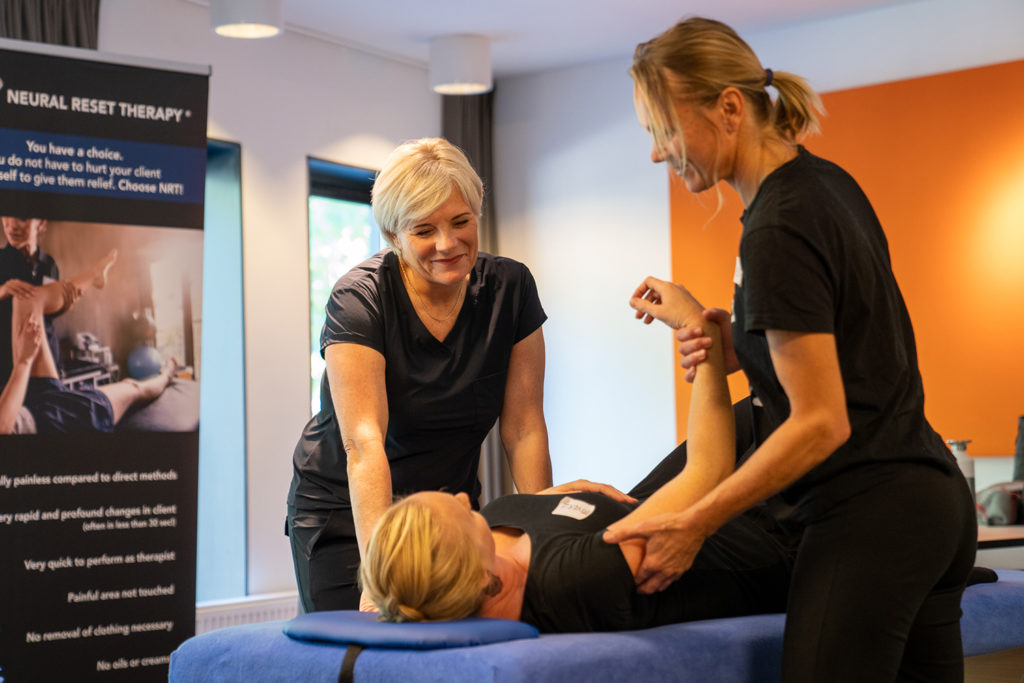
Performing all resets. For 30 minutes, the students will perform all resets on a fellow student under Yvette’s extensive supervision. One of the students will be the ‘patient’, the other the ‘therapist’. This is the moment when you can show and practice what you have learned during these two days. After that, the students switch roles. The instructor and assistant(s) will pay extra attention to ensure that the resets are performed correctly.